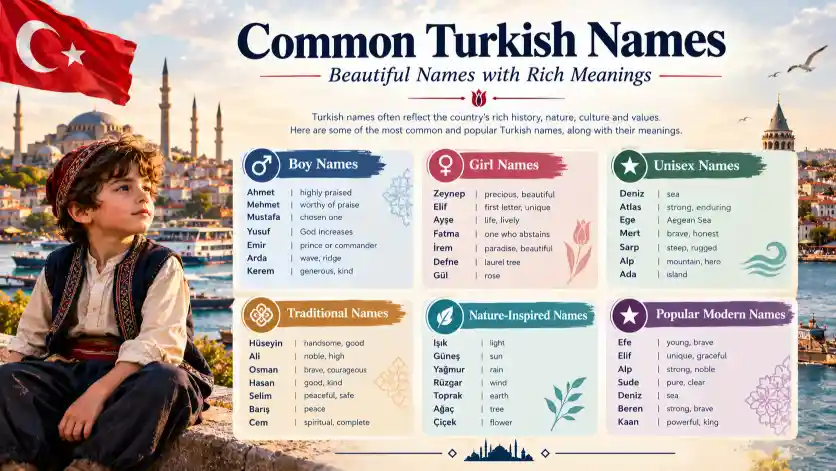
Turkish names often combine simple sounds, deep meanings, and a rich cultural history. Many popular Turkish names draw on Turkish words, Arabic and Persian traditions, Islamic history, nature, virtues, and older Turkic naming traditions.
If you are looking for common Turkish names for a baby, character, family, or fictional story, it helps to understand both the name and its cultural context. People strongly associate some names with Turkey, while neighboring cultures and languages also use others.
This guide covers common Turkish boy names, girl names, unisex names, traditional choices, modern favorites, and Turkish names with meaningful origins.
Common Turkish Boy Names
Turkish boy names often emphasize strength, courage, leadership, nature, faith, and good character. Many familiar names have long histories, and people still recognize them throughout modern Turkey.
Mehmet
Mehmet is one of the most recognizable Turkish male names. It comes from Muhammad and has a particularly strong historical and cultural presence in Turkey.
Ahmet
Ahmet comes from Ahmad, an Arabic name that conveys praise and commendation.
Mustafa
Mustafa is an Arabic name meaning “chosen” or “the chosen one.” Turkish families have used it for generations.
Ali
Ali is an Arabic name whose meanings include “high,” “exalted,” and “noble.” Families use it widely in Turkey and throughout the Muslim world.
Emre
Emre is a distinctly familiar Turkish given name. Turkish literary and cultural history features the name, which has a warm, modern sound.
Burak
Burak is a popular Turkish masculine name. Islamic tradition connects it with al-Buraq, the miraculous mount from the Prophet Muhammad’s Night Journey.
Can
Turkish speakers pronounce Can approximately like “Jan.” The Turkish word can means “soul,” “life,” or “dear person,” and families widely use it as a masculine given name.
Kerem
Kerem comes from an Arabic-origin word that conveys generosity, nobility, and kindness. Turkish families commonly choose it for boys.
Mert
Mert is a Turkish name that conveys bravery, honesty, or straightforwardness. It has a short, strong sound.
Eren
Eren is a Turkish name with historical and spiritual associations. Turkish tradition links it to a wise or spiritually mature person.
Common Turkish Girl Names
Turkish girl names often draw on flowers, nature, beauty, virtues, precious objects, and traditional cultural vocabulary.
Ayşe
Ayşe comes from Aisha, an Arabic name that conveys life or living.
Fatma
Fatma is a Turkish form of Fatimah, a highly significant name in Islamic history that families use widely throughout Turkey.
Zeynep
Zeynep is one of the most familiar Turkish feminine names. It comes from Zaynab and has a long history in Islamic cultures.
Elif
Elif comes from Alif, the first letter of the Arabic alphabet. It has a particularly elegant and familiar sound in Turkey.
Esra
Esra is a Turkish feminine name related to the Arabic name Isra, which Islamic tradition connects with the Night Journey.
Ece
Turkish usage connects Ece with a queen or beautiful woman. The name is short, simple, and distinctly Turkish in style.
Derya
Derya comes from Persian and means “sea” or “ocean.” Families in Turkey use it as a feminine name.
Selin
Selin is a popular modern Turkish feminine name. Turkish naming traditions often connect it with water or flowing water.
Ceren
Ceren is a Turkish feminine name that means or evokes a gazelle. The name has a soft and graceful sound.
İrem
İrem is a Turkish feminine name that Arabic and Islamic cultural traditions connect with a legendary garden or paradise.
Common Turkish Unisex Names
People use some Turkish names for children of any gender. These names work especially well if you want a name that does not strongly indicate gender.
Deniz
Deniz means “sea” in Turkish, and families commonly give it to children of any gender.
Derya
Derya means “sea” or “ocean” and can also be used for different genders, although usage patterns may vary.
Yağmur
Yağmur means “rain” in Turkish. Families use it as a given name, and it has a strong connection to nature.
Umut
Umut means “hope” in Turkish. Families commonly use it as a given name for children of any gender.
Özgür
Özgür means “free” or “free person.” Turkish families use it as a unisex given name.
Ekin
Ekin means “crop,” “harvest,” or cultivated growth in Turkish. Families give it to children of any gender.
Duru
In Turkish, Duru conveys clarity or purity. Families commonly use it as a feminine name, though some use it more broadly.
Popular Turkish Names for Boys
Some names remain especially familiar because Turkish families have used them across generations.
Yusuf
Yusuf comes from Joseph. It holds deep biblical and Islamic significance, and Turkish families use it widely.
İbrahim
İbrahim comes from Abraham. The name has a longstanding place in Islamic and Turkish culture.
İsmail
İsmail comes from Ishmael, and Turkish Muslims use it widely.
Hasan
Hasan is an Arabic-origin name that conveys goodness, beauty, or excellence. Families in Turkey have used it for generations.
Hüseyin
Hüseyin comes from Husayn. Islamic tradition gives the name important historical significance.
Osman
Osman comes from Uthman. The name holds special significance in Turkish history because people traditionally regard Osman I as the founder of the Ottoman dynasty.
Murat
Murat comes from Murad and means a wish, desire, or aspiration.
İrfan
İrfan conveys knowledge, understanding, or spiritual wisdom. It has a traditional Turkish character.
Hakan
Hakan is a Turkish title-name that historically refers to a ruler or khan.
Tolga
Tolga is a Turkish masculine name that refers to a traditional Turkic helmet or protective headgear.
Popular Turkish Names for Girls
Many familiar Turkish girl names have beautiful meanings connected with nature, virtues, flowers, light, and traditional culture.
Merve
Merve comes from Marwah, the name of the sacred hill of al-Marwah in Mecca.
Sibel
Sibel is a well-established Turkish feminine name, although researchers have interpreted its historical origin and meaning in different ways.
Büşra
Büşra is a Turkish form of an Arabic word meaning “good news” or “glad tidings.”
Hande
Hande is a Turkish feminine name that conveys a smile or laughter.
Gül
Gül means “rose” in Turkish and is also found in names such as Gülşah and Gülay.
Gülşah
Gülşah combines gül, meaning “rose,” with şah, meaning “king” or “ruler.” It has a traditional Persian-Turkish naming style.
Aylin
Aylin is a familiar Turkish feminine name that evokes the moon and moonlight.
Aslı
Aslı is a Turkish feminine name with literary and cultural associations, especially through the traditional story of Kerem and Aslı.
Nazlı
In Turkish, Nazlı conveys coyness, delicacy, or charm.
Damla
Damla means “drop” or “droplet” in Turkish. Turkish speakers readily recognize it as a modern name.
Traditional Turkish Names
Traditional Turkish names often preserve older linguistic, religious, or historical influences. These names can feel timeless even when they are centuries old.
Osman
Osman has a particularly strong place in Turkish history because of the Ottoman dynasty.
Süleyman
Süleyman comes from Solomon and has a long religious and historical tradition.
Selim
Selim comes from Arabic roots that convey safety, soundness, or peace. Ottoman rulers also used the name.
Murat
Murat comes from Murad and evokes a wish or desire.
Orhan
Orhan is a traditional Turkish masculine name with strong Ottoman historical associations.
Halil
Halil comes from an Arabic word meaning “close friend” or “intimate friend.” The name has a longstanding place in Turkish culture.
Nermin
Nermin is a traditional feminine name of Persian origin that conveys softness or delicacy.
Feride
Feride is a traditional feminine name that conveys uniqueness or the idea of being one of a kind.
Modern Turkish Names
Modern Turkish naming trends include short names, nature names, meaningful Turkish words, and names that work easily across languages.
Arda
Arda is a familiar modern Turkish masculine name with a short and energetic sound.
Efe
Efe is a popular Turkish masculine name. Western Anatolian cultural tradition historically uses it for a brave or respected man.
Emir
Emir comes from an Arabic title meaning “commander,” “prince,” or “ruler.” Families in modern Turkey use it widely.
Kaan
Kaan is a Turkish form of the title khan, meaning ruler. It remains a popular modern masculine choice.
Kuzey
Kuzey means “north” in Turkish. It has a distinctly modern nature-inspired style.
Nehir
Nehir means “river” in Turkish, and families primarily give it to girls.
Irmak
Irmak means “river” in Turkish, and families give it as a name, especially to girls.
Ada
Ada means “island” in Turkish, and families also use it as a feminine given name.
Defne
Defne comes from Daphne, which Greek mythology connects with the laurel tree.
Turkish Names Inspired by Nature
Nature names are an important part of modern Turkish naming. Words for the sea, sky, flowers, rain, rivers, and seasons can become beautiful given names.
Deniz
Deniz means “sea.”
Yağmur
Yağmur means “rain.”
Nehir
Nehir means “river.”
Irmak
Irmak means “river.”
Gökçe
Gökçe comes from gök, meaning “sky” or “heaven,” and can describe something sky-like or beautiful.
Aylin
Aylin evokes the moon and its light.
Bahar
Bahar means “spring,” and families use it as a feminine given name.
Çiçek
Çiçek means “flower” in Turkish.
Lale
Lale means “tulip,” a flower with deep roots in Turkish and Ottoman history.
Yasemin
Yasemin means “jasmine” and entered Turkish through the Persian and Arabic naming tradition.
Turkish Names With Beautiful Meanings
If meaning is your main priority, Turkish names offer many choices connected with positive qualities.
Umut
Umut means “hope.”
Mutlu
Mutlu means “happy” or “fortunate.”
Sevgi
Sevgi means “love” or “affection.”
Barış
Barış means “peace.”
Özgür
Özgür means “free” or “free person.”
Neşe
Neşe means “joy” or “happiness.”
Huzur
Huzur evokes peace, calm, or tranquility.
Işık
Işık means “light.”
Güzel
Güzel means “beautiful” or “beautifully.”
Şirin
Şirin has Persian origins and conveys sweetness, charm, or loveliness.
Strong Turkish Boy Names
If you want a Turkish name that sounds bold and has a powerful meaning, these options stand out.
Alp
Alp is an old Turkic word for a hero or brave warrior. It is one of the strongest examples of a name rooted in older Turkic vocabulary.
Efe
Efe has historical associations with brave and respected men in western Anatolia.
Mert
Mert evokes bravery, honesty, and straightforward character.
Hakan
Hakan evokes a ruler or khan.
Kaan
Kaan evokes the title khan and therefore has a strong leadership connection.
Yiğit
Yiğit is a Turkish word meaning “brave,” “valiant,” or “courageous.” Families also use it as a given name.
Demir
Demir means “iron” in Turkish. As a name, it evokes durability and toughness.
Sarp
Sarp can mean “steep,” “rugged,” or “difficult to climb.” As a name, it creates a tough and distinctive impression.
Elegant Turkish Girl Names
Turkish girl names can have a soft, graceful sound while carrying strong cultural or natural meanings.
Aylin
Aylin has a moon-related association and an elegant sound.
Elif
Elif is short and graceful, with a connection to the first letter of the Arabic alphabet.
İpek
İpek means “silk” in Turkish. It is a simple name that evokes natural luxury.
İnci
İnci means “pearl” in Turkish.
Lale
Lale means “tulip,” connecting the name with an important flower in Turkish cultural history.
Yasemin
Yasemin means “jasmine” and has a soft floral character.
Eylül
Eylül means “September” in Turkish. It offers a modern, season-inspired choice.
Melis
Melis is a familiar Turkish feminine name with Greek-related naming history and a pleasant modern sound.
Turkish Names From Ottoman History
Ottoman history has had a major influence on Turkish names. Sultans, statesmen, poets, and other historical figures helped keep some names familiar.
Osman
Historians traditionally regard Osman I as the founder of the Ottoman dynasty.
Orhan
Orhan was the second Ottoman ruler and is an important historical figure in the early Ottoman period.
Murad
Several Ottoman sultans bore the name Murad, which means a wish or desire.
Mehmed
Numerous Ottoman sultans bore the name Mehmed, including Mehmed II, who conquered Constantinople in 1453.
Selim
Several Ottoman sultans bore the name Selim, which comes from Arabic roots that convey safety and soundness.
Süleyman
Süleyman is especially associated with Sultan Suleiman I, one of the best-known Ottoman rulers.
How to Choose a Common Turkish Name
You can choose a Turkish name more easily when you consider its meaning, pronunciation, history, and cultural background.
Check the Original Meaning
Some Turkish names come directly from Turkish words, while others entered Turkish through Arabic, Persian, Greek, or other languages. Check each name’s original meaning instead of assuming that Turkish speakers originally created it.
Consider Pronunciation
Turkish includes letters that may be unfamiliar to English speakers, including ç, ğ, ı, ö, ş, and ü. If you plan to use the name internationally, consider how easily people can pronounce it.
Think About Cultural Context
A name can carry religious, historical, literary, or regional associations. Understanding those connections can help you choose a name respectfully.
Decide Between Traditional and Modern
Names such as Mehmet, Ahmet, Mustafa, and Fatma draw on deep traditions, while names such as Kuzey, Nehir, Ada, and Eylül feel more modern.
FAQs About Common Turkish Names
What are the most common Turkish names?
Commonly recognized Turkish names include Mehmet, Ahmet, Mustafa, Ali, Yusuf, Emre, Burak, Kerem, Ayşe, Fatma, Zeynep, Elif, and Aylin.
What is a very Turkish boy name?
Names such as Emre, Mert, Efe, Yiğit, Arda, Hakan, Kaan, and Demir have a particularly strong Turkish linguistic or cultural identity.
What is a common Turkish girl name?
Zeynep, Elif, Ayşe, Fatma, Aylin, Ece, Ceren, İrem, and Derya are familiar Turkish feminine names.
What Turkish name means strong?
Demir means “iron,” while Yiğit evokes bravery and valor. Alp is an old Turkic term for a hero or warrior.
What Turkish name means hope?
Umut is the Turkish word for “hope” and is also used as a given name.
What Turkish name means peace?
Barış means “peace” in Turkish and families use it as a given name, especially for boys.
What Turkish name means sea?
Deniz means “sea” in Turkish, and families commonly give it to children of any gender.
Are Turkish names Arabic?
Not all Turkish names are Arabic. Turkish naming traditions include names from Turkic languages as well as names borrowed or adapted from Arabic, Persian, Greek, and other linguistic traditions.
What are some unique Turkish names?
Alp, Efe, Yiğit, Kuzey, Demir, Gökçe, Nehir, İpek, and Eylül can be distinctive choices depending on the naming style and region.
Conclusion
Common Turkish names reflect the many layers of Turkish language and history. Some come directly from Turkish words, while others draw on Arabic, Persian, Greek, or older Turkic roots that Turkish culture embraced over time.
For boys, names such as Mehmet, Emre, Mert, Efe, Kerem, Alp, Yiğit, and Demir offer different combinations of tradition, strength, and Turkish identity. For girls, Zeynep, Elif, Ayşe, Aylin, Ece, İpek, Lale, and Ceren provide familiar choices with cultural and linguistic depth.
Whether you want a traditional name, a modern Turkish name, a nature-inspired choice, or a name with a strong meaning, explore the language and cultural history behind it to make a more informed choice.
Read More:
- Strong Boy Names : With Deep Meanings
- Unique Italian Last Names: 100+ Beautiful Ideas (2026)
- Names Meaning Sky: 100+ Beautiful Ideas (2026)

I’m Simran Jay, a passionate name researcher and writer focused on meaningful, distinctive, and modern names. I enjoy exploring name origins, meanings, and trends, and I create simple, engaging guides to help readers find the right name.