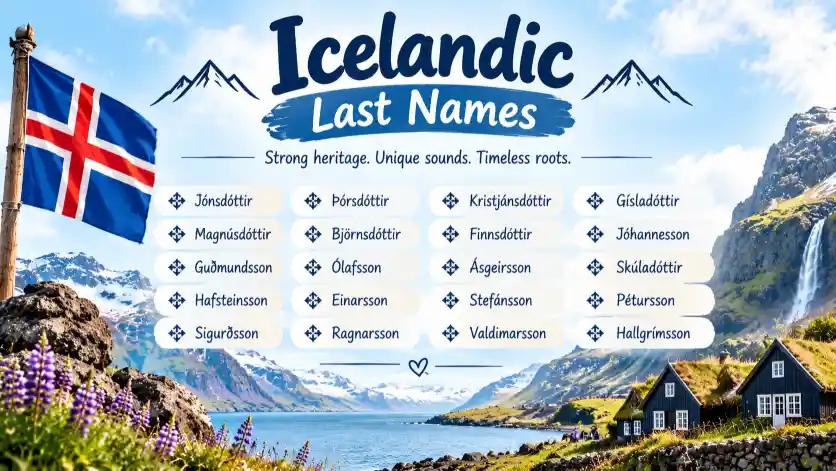
Icelandic last names are different from surnames in many other countries. Instead of always passing down one family surname, Icelanders often use patronymic or matronymic names based on a parent’s first name. These naming traditions give Icelandic names a special connection to family history and culture.
If you are researching Icelandic heritage, choosing a name for a character, or exploring Nordic surnames, this guide covers traditional Icelandic last names, popular examples, names for human beings, and rare Icelandic family names.
How Icelandic Last Names Work
Icelandic naming traditions differ from those in countries where everyone in a family usually shares the same inherited surname. Many Icelanders use a name based on their father’s or mother’s first name.
Patronymic Surnames
A patronymic name comes from a person’s father’s first name. The traditional endings differ by gender.
- -son means “son.”
- -dóttir means “daughter.”
For example, if a father is named Jón, his son might be named Jónsson, while his daughter might be named Jónsdóttir.
These names usually identify a parent rather than a permanent family surname. As a result, siblings may have different surname endings.
Matronymic Surnames
A matronymic name comes from a person’s mother’s first name. Icelandic naming traditions allow people to use their mother’s name instead of their father’s.
For example, a child whose mother is named Anna might use Annuson or Annudóttir, depending on the chosen form and naming tradition.
Inherited Family Surnames
Some Icelanders have inherited family surnames that do not change from father to daughter or son to daughter. These names are less typical than patronymic and matronymic names.
Important: Icelandic naming rules have specific requirements, so not every name that looks Icelandic is a traditional or legally accepted Icelandic surname.
Popular Icelandic Last Names
Many familiar Icelandic surnames come from a parent’s first name. The following examples show common naming patterns.
- Jónsson : Son of Jón
- Jónsdóttir : Daughter of Jón
- Ólafsson : Son of Ólafur
- Ólafsdóttir : Daughter of Ólafur
- Guðmundsson : Son of Guðmundur
- Guðmundsdóttir : Daughter of Guðmundur
- Sigurðsson : Son of Sigurður
- Sigurðardóttir : Daughter of Sigurður
- Einarsson : Son of Einar
- Einarsdóttir : Daughter of Einar
- Magnússon : Son of Magnús
- Magnúsdóttir : Daughter of Magnús
- Björnsson : Son of Björn
- Björnsdóttir : Daughter of Björn
- Gunnarsson : Son of Gunnar
- Gunnarsdóttir : Daughter of Gunnar
- Kristjánsson : Son of Kristján
- Kristjánsdóttir : Daughter of Kristján
- Stefánsson : Son of Stefán
- Stefánsdóttir : Daughter of Stefán
Jónsson and Jónsdóttir are classic examples of Icelandic naming patterns. Their endings reflect the person’s relationship to a parent, not necessarily membership in a permanent surname family.
Traditional Icelandic Last Names
Traditional Icelandic surnames often follow naming patterns that have existed for centuries. Many use the names of parents or ancestors.
Traditional Icelandic Names Ending in -son
These examples use the masculine ending that traditionally means “son of.”
- Árnason : Son of Árni
- Benediktsson : Son of Benedikt
- Davíðsson : Son of Davíð
- Friðriksson : Son of Friðrik
- Haraldsson : Son of Haraldur
- Hjálmarsson : Son of Hjálmar
- Ingólfsson : Son of Ingólfur
- Jakobsson : Son of Jakob
- Kjartansson : Son of Kjartan
- Pálsson : Son of Páll
- Ragnarsson : Son of Ragnar
- Róbertsson : Son of Róbert
- Þórðarson : Son of Þórður
- Valdimarsson : Son of Valdimar
- Vilhjálmsson : Son of Vilhjálmur
Traditional Icelandic Names Ending in -dóttir
These examples use the feminine ending that traditionally means “daughter of.”
- Árnadóttir : Daughter of Árni
- Benediktsdóttir : Daughter of Benedikt
- Davíðsdóttir : Daughter of Davíð
- Friðriksdóttir : Daughter of Friðrik
- Haraldsdóttir : Daughter of Haraldur
- Hjálmarsdóttir : Daughter of Hjálmar
- Ingólfsdóttir : Daughter of Ingólfur
- Jakobsdóttir : Daughter of Jakob
- Kjartansdóttir : Daughter of Kjartan
- Pálsdóttir : Daughter of Páll
- Ragnarsdóttir : Daughter of Ragnar
- Róbertsdóttir : Daughter of Róbert
- Þórðardóttir : Daughter of Þórður
- Valdimarsdóttir : Daughter of Valdimar
- Vilhjálmsdóttir : Daughter of Vilhjálmur
The exact spelling depends on the parent’s name and Icelandic grammatical forms. These examples illustrate the general pattern rather than a complete legal naming guide.
Icelandic Last Names for Men
Icelandic men commonly use surnames ending in -son when the name comes from their father’s first name. These examples can also help you understand Icelandic character names.
- Jónsson
- Ólafsson
- Guðmundsson
- Sigurðsson
- Einarsson
- Magnússon
- Björnsson
- Gunnarsson
- Kristjánsson
- Stefánsson
- Árnason
- Benediktsson
- Davíðsson
- Haraldsson
- Ragnarsson
- Pálsson
- Þórðarson
- Valdimarsson
- Vilhjálmsson
- Jakobsson
These names are useful examples of the traditional masculine naming pattern. A person’s actual surname depends on the first name of the parent used to form it.
Icelandic Last Names for Women
Icelandic women traditionally use -dóttir when their surname comes from their father’s first name. A matronymic name can also use this ending when it comes from the mother’s name.
- Jónsdóttir
- Ólafsdóttir
- Guðmundsdóttir
- Sigurðardóttir
- Einarsdóttir
- Magnúsdóttir
- Björnsdóttir
- Gunnarsdóttir
- Kristjánsdóttir
- Stefánsdóttir
- Árnadóttir
- Benediktsdóttir
- Davíðsdóttir
- Haraldsdóttir
- Ragnarsdóttir
- Pálsdóttir
- Þórðardóttir
- Valdimarsdóttir
- Vilhjálmsdóttir
- Jakobsdóttir
The ending -dóttir means “daughter,” making it one of the most recognizable features of Icelandic surnames.
Unique Icelandic Last Names
Some Icelandic surnames look distinctive because they contain Icelandic letters, less familiar personal names, or unusual combinations of sounds.
- Þórðarson
- Þórðardóttir
- Þorsteinsson
- Þorsteinsdóttir
- Þórhallsson
- Þórhallsdóttir
- Ásgeirsson
- Ásgeirsdóttir
- Baldursson
- Baldursdóttir
- Eyjólfsson
- Eyjólfsdóttir
- Hallgrímsson
- Hallgrímsdóttir
- Hrafnsson
- Hrafnsdóttir
- Ingvarsson
- Ingvarsdóttir
- Snorrason
- Snorradóttir
These names may look unusual to readers unfamiliar with Icelandic, but many follow established naming patterns.
Rare Icelandic Family Surnames
Some Icelandic families use inherited surnames rather than the more common patronymic or matronymic system. Such names may come from older family histories, foreign influences, or particular naming traditions.
Examples of surnames associated with Icelandic families include:
- Blöndal
- Thorlacius
- Kvaran
- Laxness
- Vídalín
- Stephensen
- Möller
- Finsen
- Scheving
- Zimsen
- Waage
- Briem
- Tuliníus
- Melsteð
- Hjaltalín
These inherited surnames do not all follow the -son and -dóttir pattern. Their history and distribution vary, and some have connections to other European naming traditions.
Icelandic Last Names With Norse Roots
Icelandic naming traditions have deep connections to Old Norse culture. Many Icelandic first names used to create surnames have roots in Norse mythology, nature, or traditional personal names.
Names Connected to Norse Traditions
- Þórðarson : Son of Þórður
- Þorsteinsson : Son of Þorsteinn
- Ásgeirsson : Son of Ásgeir
- Ingólfsson : Son of Ingólfur
- Ragnarsson : Son of Ragnar
- Björnsdóttir : Daughter of Björn
- Sigurðsson : Son of Sigurður
- Hrafnsson : Son of Hrafn
Why These Names Matter
Names such as Þórður, Þorsteinn, and Hrafn reflect Iceland’s linguistic history. The surname ending then connects the person to a parent.
A surname’s Norse connection often comes from the personal name at its root, rather than from the surname being an inherited family name.
Icelandic Last Names With Beautiful Meanings
Many Icelandic surnames identify a parent rather than describing a personality trait or natural feature. Their meanings become clearer when you understand the personal name behind them.
- Jónsson : Son of Jón
- Ólafsdóttir : Daughter of Ólafur
- Björnsson : Son of Björn; Björn means “bear”
- Björnsdóttir : Daughter of Björn; Björn means “bear”
- Árnason : Son of Árni
- Gunnarsson : Son of Gunnar
- Sigurðsson : Son of Sigurður
- Einarsson : Son of Einar
- Magnúsdóttir : Daughter of Magnús
- Ragnarsson : Son of Ragnar
For the most accurate meaning, research the original personal name as well as the surname ending. A patronymic surname does not usually have a separate symbolic meaning of its own.
Icelandic Last Names for Fictional Characters
Icelandic surnames can add cultural detail to a story, game, or fictional family. Choose a name that fits the character’s background and use the correct ending for the intended naming pattern.
Strong Icelandic Character Names
- Ragnarsson
- Þorsteinsson
- Guðmundsson
- Sigurðsson
- Ásgeirsson
- Haraldsson
- Þórðarson
- Vilhjálmsson
Female Icelandic Character Names
- Ragnarsdóttir
- Þorsteinsdóttir
- Guðmundsdóttir
- Sigurðardóttir
- Ásgeirsdóttir
- Haraldsdóttir
- Þórðardóttir
- Vilhjálmsdóttir
Tips for Naming Characters
- Match the surname to the character’s parent name if you want to follow Icelandic naming traditions.
- Keep Icelandic letters when possible, especially Þ, ð, and accented vowels.
- Avoid treating -son and -dóttir as ordinary inherited surnames when cultural accuracy matters.
- Research real names before using them for historical or contemporary Icelandic characters.
How to Choose an Icelandic Last Name
Choosing an Icelandic surname depends on if you want an authentic name, a family-history connection, or a name for a fictional character.
Understand the Naming Pattern
Start by deciding if you want a patronymic, matronymic, or inherited surname.
- Patronymic: Based on the father’s first name.
- Matronymic: Based on the mother’s first name.
- Inherited surname: Passed down as a family name.
Check the Correct Ending
The traditional masculine ending is -son, while the traditional feminine ending is -dóttir. The correct form depends on the parent’s name and Icelandic grammar.
Keep the Original Spelling
Icelandic uses letters that do not appear in the standard English alphabet, including Þ and ð. Preserving these letters can help maintain the name’s original form.
Consider the Purpose
For a family-history project, use verified records. A fictional character, choose a name that suits the character’s background. For a baby name, check current Icelandic naming rules if you plan to register the name in Iceland.
The most authentic choice reflects both the person’s family connection and Icelandic naming customs.
FAQs About Icelandic Last Names
What Is the Most Common Icelandic Last Name?
Jónsson and Jónsdóttir are well-known examples of Icelandic patronymic names. Many Icelandic surnames follow similar patterns based on a parent’s first name.
Why Do Icelandic Last Names End in -son or -dóttir?
The ending identifies a relationship to a parent. -son means “son,” while -dóttir means “daughter.” These endings are a central part of traditional Icelandic naming.
Do Icelandic Families Share the Same Last Name?
Not always. Children may receive surnames based on a parent’s first name, so a brother and sister can have different surname endings. Their surnames may also differ from their parents’ surnames.
Are Icelandic Last Names Inherited?
Many are not inherited in the same way as surnames in countries where a family passes down one permanent surname. However, some Icelandic families do have inherited family names.
What Is a Female Icelandic Last Name?
Traditional examples include Jónsdóttir, Ólafsdóttir, Björnsdóttir, and Guðmundsdóttir. The ending -dóttir traditionally means “daughter of.”
What Is a Male Icelandic Last Name?
Traditional examples include Jónsson, Ólafsson, Björnsson, and Guðmundsson. The ending -son traditionally means “son of.”
Do Icelandic Last Names Have Meanings?
Yes, but their meaning usually comes from the personal name they use and the relationship expressed by the ending. For example, Björnsson means “son of Björn,” and Björn means “bear.”
Can I Use an Icelandic Last Name for a Fictional Character?
Yes. Icelandic surnames can work well for fictional characters, especially those with Icelandic or Nordic backgrounds. For cultural accuracy, match the name to the character’s parent and use the correct form.
Conclusion
Icelandic last names offer a fascinating look at family history, language, and Nordic culture. Names such as Jónsson, Jónsdóttir, Guðmundsson, and Sigurðardóttir demonstrate how Icelandic naming traditions connect a person to a parent.
Unlike many inherited surnames, traditional Icelandic names often change according to the parent’s first name and the child’s gender. Understanding the difference between patronymic, matronymic, and inherited surnames helps you choose a name with greater accuracy.
If you are researching Icelandic heritage or naming a fictional character, the best choice is one that respects the language and the tradition behind it.
Read More:
- Beach House Names: Cute, Funny, and Clever Ideas
- Cool Baseball Team Names: 100+ Best Ideas (2026)
- Santa Names: 100+ Fun & Festive Ideas (2026)

I’m Simran Jay, a passionate name researcher and writer focused on meaningful, distinctive, and modern names. I enjoy exploring name origins, meanings, and trends, and I create simple, engaging guides to help readers find the right name.